
I have been on 4 beautiful Himalayan treks till date, and having walked 150+ kilometers on Himalayan terrain, if I had to choose one thing that everyone must learn, it would be this:
You MUST prepare well.
Know your gear.
Know your fitness.
Understand what the sport really asks for.
With the upcoming spring and summer season, I know many of you are already planning your next trip to the mountains. So I’ve compressed all of my experiences into this structured blog — so you can truly enjoy the mountains.
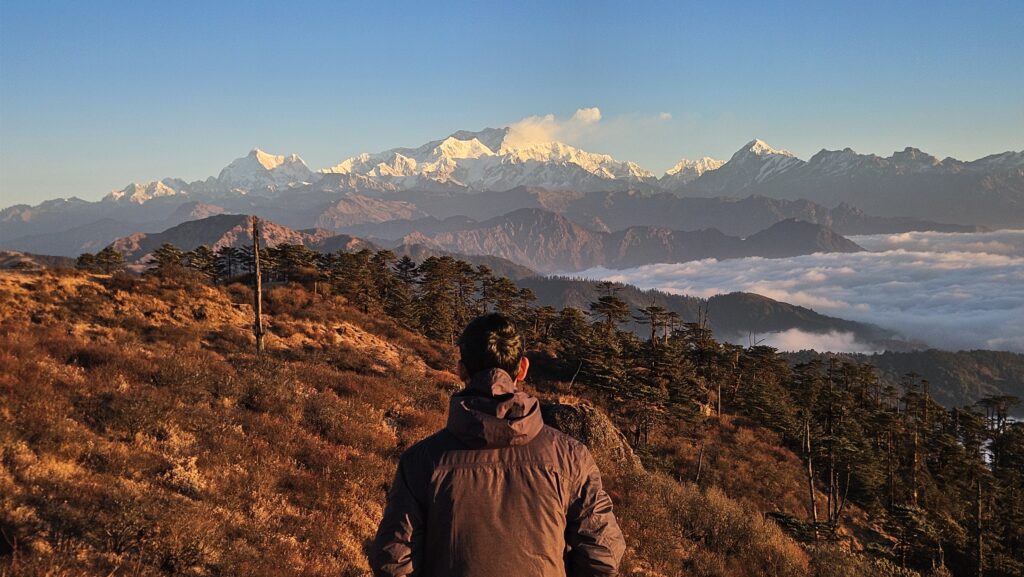
Because while the Himalayas are breathtaking, they do demand your seriousness as well.
Note: This blog focuses only on treks done with organizations (like Indiahikes, Trek The Himalayas, etc.) and not DIY alpine-style hikes. I am not an experienced DIY trekker, so it wouldn’t be fair to guide you on that.
Choosing the right trek
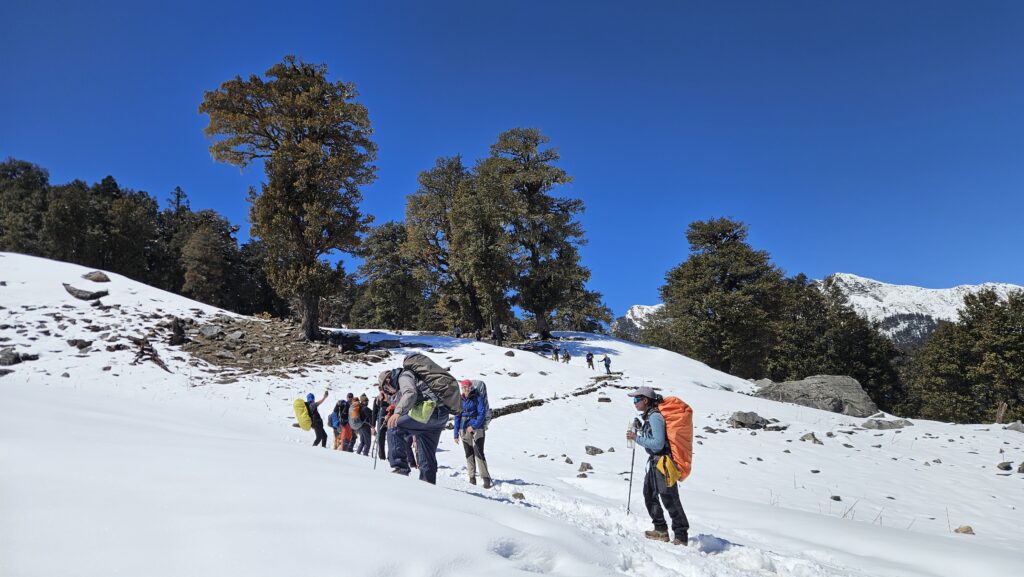
One of the biggest beginner mistakes?
Choosing the “most beautiful” trek instead of the most suitable one.
You haven’t benchmarked your body yet against Himalayan terrain — so don’t let Instagram choose your trek.
Here’s a simple framework:
1. Prefer Lower Altitudes (≤ 12,000 ft)
You don’t yet know how your body reacts to altitude.
Going too high, too fast increases the probability of AMS (Acute Mountain Sickness).
Introduce your body gradually.
2. Prefer Shorter Trekking Days
Shorter days give you bandwidth to:
- Understand your natural pace
- Improve punctuality
- Help others
- Actually soak in the surroundings
Long summit pushes can feel overwhelming if you’re not used to packing, early wake-ups, and sustained effort.
3. Prefer Fewer Days (5–6 Days Ideal)
- 2 travel days
- 4 solid trekking days
In my opinion, a 6-day trek is ideal. It’s enough to:
- Experience real Himalayan terrain
- Discover how you behave as a trekker
- Learn your strengths & weaknesses
4. Thumb Rule for Difficulty
Beginners starting fitness for the first time: Easy / Easy-Moderate
Fit Beginners: Easy / Easy-Moderate / Moderate
The fitter you are, the more flexible these rules become.
But remember — the goal isn’t to survive.
The goal is to experience and enjoy.
Trek Suggestions
Easy:
Easy-Moderate:
Moderate:
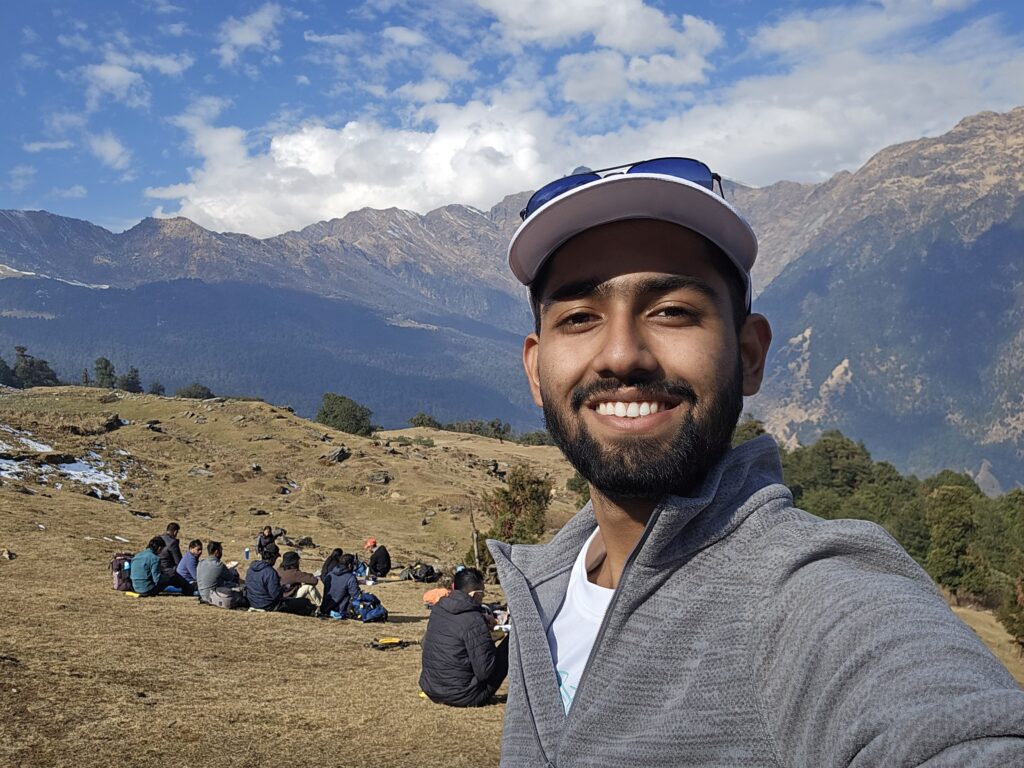
Here, I have shared the trek details as shared by Indiahikes, I personally do recommend them as the go-to organiser for treks, but you can and should checkout other trekking organisations’ offerings before you decide who to go with.
The above recommendations have a varied mix – grasslands, passes and summit treks and I think it will help you evaluate your options better.
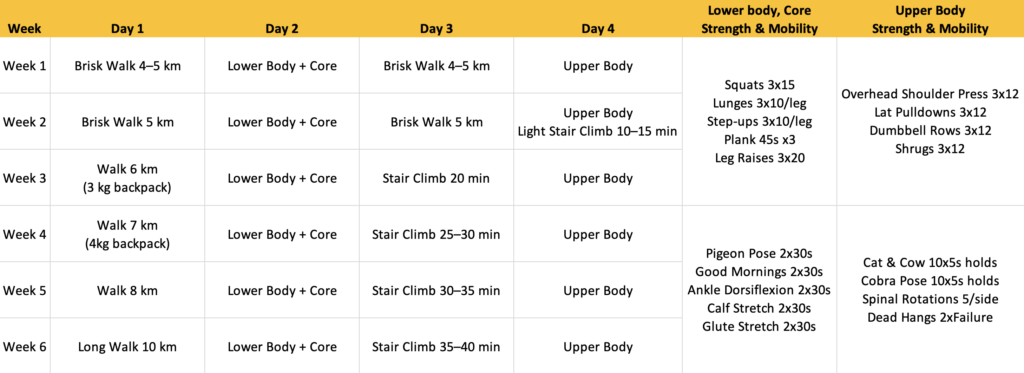
Fitness strategy (6–8 Weeks Before Trek)
High-altitude trekking demands:
- Cardiovascular endurance
- Leg strength
- Core stability
- Recovery capacity
Not gym aesthetics.
Benchmark Goal Before Trek
Before departure, you should comfortably be able to:
- Jog 5 km in under 40 minutes (Cardiovascular Endurance)
- Climb 10–12 floors without stopping (Leg Strength, Cardiovascular Endurance)
- Do 30–40 continuous squats(Leg Strength, Core stability)
- Carry a 5 kg backpack for 5 km(Full-Body strength, Cardiovascular Endurance)
If this feels easy → you’re on track.
Here is a solid 6-week plan to help you get trek ready:
Avoid:
- Skipping warm-ups before lifting sessions
- Random HIIT with no endurance base
- Last-week crash training
- Ignoring recovery & sleep
Optimising Flight expenses
Flights often become the biggest expense!
Here’s how to control that:
- Book at least 2 months in advance
- Prefer flexi tickets — Himalayan weather is unpredictable, this helps get complete refunds and free date changes.
- Use aggregators like Skyscanner for comparison
- Hunt for credit card offers & cashback deals to get a better price
Flexibility > cheapest fare.
Budget Gear Strategy (Buy some, rent most)
For all my treks, I’ve rented most expensive gear because:
- I trek 1–2 times a year
- These items need maintenance
- High upfront cost doesn’t justify usage
If you’re planning aggressive outdoor usage, buying may make sense.
Most Expensive Items
- Trekking Shoes
- Backpack (50–60L)
- Padded/Down Jacket
If you’re not a frequent trekker → Rent from a trusted store.
Check reviews. Inspect before renting.
What You Should Buy
- Thermals
- Fleece
- Gloves
- Woollen socks
- Base layers
(Hygiene reasons — these are not ideal for renting.)
It’s completely fine if you are not clear on this yet, I have shared more details on what to pack in the later part of this blog.
Setting the Right Mindset: What Trekking Really Means
This may be subjective — but it changed everything for me.
1. Show Up Prepared
Preparation is respect.
You don’t want to be an inconvenience to your team.
2. Be Responsible
Don’t litter.
There is no municipality up there.
Leave the trail better than you found it.
3. Trekking Is a Team Sport
If someone struggles, you slow down.
If you struggle, someone helps you.
Small gestures matter enormously in the mountains.
4. Be Punctual
Late starters are always chasing the day.
Prepared trekkers experience the day.
5. Be Present
Put the phone away.
Listen to the wind.
Observe the silence.
Talk to strangers who become friends.
The Himalayas have a strange way of introducing you to a new version of yourself.
6. Keep Noise Levels Low
You’re walking through a fragile ecosystem.
Loud noise disturbs wildlife.
We are guests there.
Some practical hacks
- Borrow gear from friends
- Rent near base village
- Book travel early
- Avoid peak May rush
- Carry homemade snacks
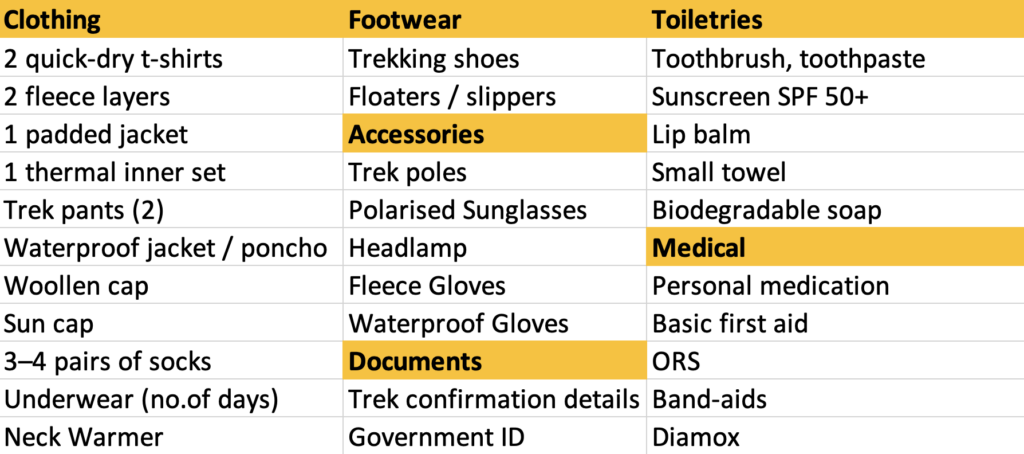
Packing checklist
Below mentioned items cover 95% of the necessities that you will need when outdoors. I will leave the rest 5% to your personal needs.
Pro Tip: You have no idea how bad ‘just in case’ can feel like at high altitudes. Make sure to pack light.
If you are still looking for more information, this article can prove to be a great read.
Factor in the hidden costs
This might sound like a pessimistic take, but being mentally and financially prepared for these situations can be a real lifesaver.
When we plan a trek, we usually calculate the obvious costs — trek fee, flights, gear, food. But the mountains are unpredictable, and there are always a few expenses that people forget to factor in.
Here are a few scenarios worth preparing for:
Medical Evacuation
The most important one!
If you develop AMS, dehydration, injury, or severe fatigue, the trek leader may decide to evacuate you to the nearest medical facility.
Depending on the trek, evacuation could involve:
- Porter/mule assistance down the trail
- Jeep transfer from the base village
- Additional accommodation near the hospital
These expenses are usually not covered by trek operators.
In remote regions, evacuation logistics alone can cost ₹3,000 – ₹10,000+ depending on distance and urgency.
Having a small emergency buffer helps avoid panic decisions.
Last-Minute Gear Issues
This happens more often than people think.
Examples:
- broken backpack strap
- damaged shoe sole
- forgotten gloves or thermals
- lost headlamp
You might need to buy or rent replacements at the base village, where prices can be higher due to limited availability.
Emergency Cash
Some base villages have:
- poor network
- no ATMs
- limited digital payment options
Always carry ₹2–3k in cash for emergencies.
A Simple Rule I Follow
Whenever I estimate the cost of a trek, I add a 10–15% buffer to the total budget.
In most cases you won’t need it.
But if something unexpected happens, you’ll be grateful that you planned ahead.
How Much does a Typical Himalayan Trek Actually Cost
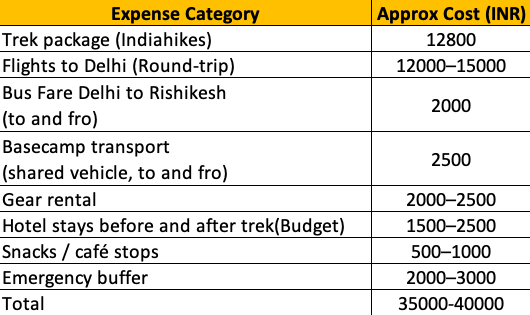
Let’s take a real-world example to understand the actual cost of a Himalayan trek.
For this example, I’ll use the Kuari Pass trek with Indiahikes.
The trek lasts 6 days, reaches 12,516 ft, and is considered an moderate trek suitable for fit-beginners.
Here is the budget breakdown for someone travelling from a place within India:
₹35,000 – ₹40,000 for the entire trek (This is relatively upper-cap)
You can push this closer to ₹30–35k or lower if:
- you book flights/trains early
- borrow gear from friends/already have gear
- skip unnecessary purchases
- opt for an organisation with a lower trek fee
Or it can exceed if:
- you add sightseeing days
- you buy all your gear
- flights are expensive
From my observations and budgeting, Treks in Uttarakhand are cheaper compared to treks in other states such as Jammu & Kashmir and Himachal Pradesh(More trek fee and higher transport charges are the main reasons most of the times, brings a delta of approx. 5000 INR)
Final Thoughts
Trekking isn’t expensive, being unprepared is.
The Himalayas test your mindset, consistency, and groundedness.
If you prepare well — physically, financially, and mentally — your trek won’t just be a trip.
It will be a deeply transformative experience.
And trust me — few experiences in life compare to earning your view at 12,000 feet.
You may also like
If stories of slow travel, mountains, and meaningful journeys resonate with you, you might enjoy these as well:
- Exploring Kinnaur — my experiences as I explored this remote corner of Himachal
- Riding across the Konkan Coastline — an epic adventure along India’s most epic beaches
- How I plan budget trips — practical tips for travellers
- Top weekend destinations from Bengaluru – if you are looking for a short getaway
- Workation from Bir-Billing – The dream workation experience
Also, do follow me on instagram to stay in touch!